
What happened?!?!
Looking at Arnica and Nat sulph for head injuries…

Head injuries can encompass many things: concussion, skull fractures, contusions, subdural hematomas, scalp wounds, or even injuries to the underlying tissues and blood vessels in the head.

For this article, we’re going to address those head injuries which involve a real whack to the noggin (or, not, as it turns out!), generally resulting in a traumatic brain injury (TBI) or mTBI (mild traumatic brain injury).
When I was a kid, you would hit your head and that was the end of that. Unless you hit it so hard you got a concussion — that got the parents’ attention. Turns out a concussion is a mild traumatic brain injury (Mayo Clinic 2022). And, it also turns out you don’t have to hit your head all that hard (if at all!) to get a concussion/brain injury.
How could you get a concussion without hitting your head?
Anything that can cause the head and brain to move rapidly back and forth… Sudden stops like car crashes, violent shaking, contact sports, even blast injuries (McKee and Robinson 2014).
(I’m beginning to understand, all these years later, that a head injury is a head injury and probably shouldn’t be dismissed too easily.)
How do you know if you or your child has suffered a concussion?
John Hopkins Medicine tells us to look for:
loss of consciousness
severe headache that doesn’t dissipate
nausea and/or vomiting
loss of memory (“What happened?!”)
difficulty with walking and talking
one-sided weakness
seizures
behavior changes
blood or clear fluid draining from the ears or nose
one pupil is dilated or looks larger than the other; it doesn’t constrict when exposed to light
Note: moderate to severe head injuries require immediate medical attention where they will evaluate your vision, hearing, strength, balance, coordination and reflexes.
What to do if you or your child suffers a mild concussion?
Specific treatment will be determined by your doctor, but generally speaking may include:
ice
rest
ointment and bandage; stitches
observation is very important. In lesser instances, home observation will suffice. In severe situations, hospitalization may be required for more intensive observation.
Be sure to seek medical attention if you are experiencing any of the above listed symptoms.
How can homeopathy help?
First Aid with Homeopathy (Ratera 2016, p. 199) talks about the “usefulness of homeopathic remedies as adjuvant to necessary conventional measures.” In case you didn’t already know, homeopathy works so well alongside conventional medicine!
There are two major go-to homeopathic remedies for head injuries: Arnica and Natrum sulphuricum.
Every book I looked in for homeopathic remedies for head injuries lists Arnica as the first remedy to use. Why? Number one, Arnica is pretty much the first remedy for any injury. Number two… well, it’s Arnica! So good for so many things!!
Let’s see how Arnica and Nat sulph stack up in the following head injury rubrics†:
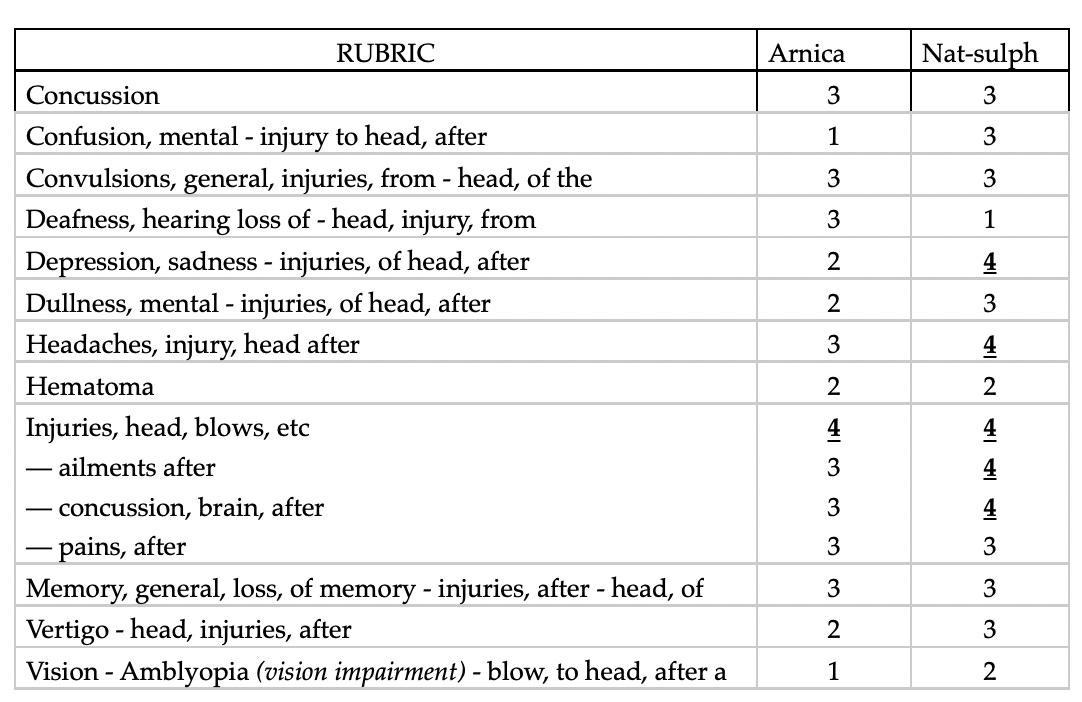
One might think looking at these two brief comparisons of the remedies* that Nat sulph would be the go-to remedy for a head injury. However, look a little closer… most of the rubrics say, “after.”
E.A. Farringon (2018, p 270-271) says, “Arnica is applicable to both the acute and the chronic effects of injuries. The acute injuries for which it is useful are the following: simple bruises… concussions of the brain or spine or of both. We have no remedy which equals Arnica in these last-named cases. Even compression of the brain comes within the range of Arnica, whether this compression be the result of a displaced fragment of bone in cranial fracture, or the result of effusion of blood within the cranial cavity. Arnica can not, of course, cure in the former of these cases; an operation is demanded in order to obtain permanent relief.”
Richard Pitt (2015, p. 48) says, “as we know, all injuries basically start with Arnica. It fits the nature of so many injuries, especially at the beginning of an injury, but also very much for chronic consequences of injuries.” This is an important point in differentiating Arnica and Nat sulph. To sum it up too neatly, Arnica is more indicated immediately after the head injury and Nat sulph would come in later as a clean up crew. However, that’s not exactly true; there are more nuances to it, of course. But, it’s a good place to start.
Let’s keep looking…
(It is true that most home users of homeopathy have Arnica at hand — it is, after all, known as “the gateway” homeopathic remedy because it has such a huge range of uses in treating so many conditions, especially as related to trauma, injuries and surgeries. Arnica is included in virtually every basic homeopathic remedy kit.)
Some of the keynotes of Arnica (Morrison 1993):
bruising or bruised sensation
touch aggravates — they may say, “leave me alone, I’m fine!”
irritability (see above)
“answers questions correctly then falls asleep as in concussion or delirium”
stupor after head injury
fear of being touched or bumped (see above)
Some more Arnica keynotes from Morrison’s new book, Clinically Verified Materia Medica, Volume 1‡ (2025):
worse for noise after injury of head or neck
throbbing, pulsating headache, often with flushes and nausea
stitching from temple to temple
shuts self alone in room during headache
“In the concussion, the patient may slip in and out of coma**, answers questions in a fog then sleeps again, believes there is nothing wrong and wants to be left alone.”
To clarify further on Arnica from Dr. Morrison’s new book (2025, p. 186), the “trauma created various defensive reactions — the first of which is denial… immediately declaring, ‘I’m fine.’… Other patients said that they were unable to ask for or accept help no matter how dire the circumstance… patients stated a need to remain in control by which they meant to hide or minimize the trauma.”
Natrum sulphuricum keynotes (Morrison 1993‡):
confusion or mental dullness after a head injury
general aggravation from injury to head or spine
convulsions which begin after head injury**
headache after head injury
Dr. Ratera (2016) says of Nat sulph: “Consequences of head trauma: vertigo, absences, blindness, coma, concussion, convulsions, headache, dullness, madness, sadness, suicidal thoughts, and memory loss.” (The key word to me, here, is “consequences.”) “Often, people who have suffered head injuries present immediately or after some time, with headaches, dizziness, memory loss, bouts of distraction, absences or epileptiform (brain activity that resembles that of epilepsy) seizures, and other disorders of concentration. These disorders can become chronic and be extremely annoying” — Nat sulph is his answer.
But, once again, it’s not as clear cut as recent head trauma = Arnica and lingering effects of head trauma = Nat sulph. (That would be too easy!) Arnica, too, can be very helpful way down the road for old head traumas. (A quick search of “Arnica” and “ailments from” in Radar Opus software shows: “Head - injuries, head, blows, etc - ailments, after” and there sits Arnica in bold type. Nat sulph is there, too, in bold underline.)
Back to Farrington (2018, p. 271), “In the chronic effects of injury we may use Arnica when diseases (which may even be entirely foreign in their appearance to the ordinary symptomatology of the drug) may be traced to a traumatic origin. No matter what that disease may be whether of the brain, eyes, lungs or nerves, if the injury is the exciting cause, the administration of Arnica is proper.” (See? not so clear cut, right?)
So, what does Dr. Farrington (2018, p. 849) have to say about Nat sulph? “In the chronic effects of injury, especially to the head, Natrium sulph is almost indispensable.”
… But, then again, it is as simple as what I wrote earlier. If you have hit your head, start with Arnica. If there are lingering effects of that head injury and Arnica isn’t taking care of business, swap to Nat sulph. … and, if years down the line you think, “you know, I haven’t felt right ever since I hit my head,” give Arnica a try.
If you readily take part in “brain rattling” activities, you might want to keep both Arnica and Nat sulph handy.
Julia Coyte, CHom
Classically Practical homeopath
#wellnessawaits
Arnica and Nat sulph are not the only two well-indicated remedies for head injuries — they are just the most commonly available and well known remedies for head injuries (in the US). To read further on homeopathic head injury remedies, consider subscribing to Ruminating on Remedies: Digging Deeper. The first of the next two head injury comparisons will be out in the next week (or so).
*Homeopathic repertories are laid out giving a number for each remedy and how well indicated that remedy is for the specific rubric. In Murphy, 4 is the highest (most well-indicated) remedy.
**Be certain to seek medical assistance in these conditions!
†All the remedies listed in these rubrics (sometimes a couple, sometimes dozens) are all potentially appropriately indicated — it’s just that some are more strongly indicated in a stand-alone rubric. For today, we are just comparing Arnica and Nat sulph. However, it’s important to remember that the right remedy in a case is the right remedy, regardless of how strongly indicated the remedy may be. Homeopathy is so full of nuance and minutiae!
‡This is a bit unfair to Nat sulph as volume 1 stops at Euphrasia! I wish I had the other volumes but they have yet to be published!
Reference list
Dewey, W. A., 2003. Practical Homoeopathic Therapeutics. accessed through Radar Opus software. B Jain Pub Pvt Limited.
Farrington, E. A., 2018. Lectures on Clinical Materia Medica in Family Order. New Delhi: B. Jain Publishers, LTD.
John Hopkins Medicine, 2020. Head Injury [online]. John Hopkins medicine. Available from: https://www.hopkinsmedicine.org/health/conditions-and-diseases/head-injury.
Mayo Clinic , 2022. Concussion - Symptoms and Causes [online]. Mayo Clinic. Available from: https://www.mayoclinic.org/diseases-conditions/concussion/symptoms-causes/syc-20355594.
McKee, A. C. and Robinson, M. E., 2014. Military-related traumatic brain injury and neurodegeneration. Alzheimer’s & Dementia [online], 10 (3), S242–S253. Available from: https://pmc.ncbi.nlm.nih.gov/articles/PMC4255273/.
Morrison, R., 1998. Desktop companion to physical pathology. Nevada City, Calif.: Hahnemann Clinic Publ.
Murphy, R., n.d. Homeopathic Remedy Guide. accessed through Radar Opus 2.2.16.
Pitt, R., 2015. Comparative materia medica : integrating new and old remedies. San Francisco, California: Lalibela Publishing.
Ratera, Dr. M. M., 2016. First Aid with Homeopathy. Germany: Narayana Verlag.
Schmukler, A. V., 2006. Homeopathy : an A to Z home handbook. Woodbury, Minn.: Llewellyn Publications.